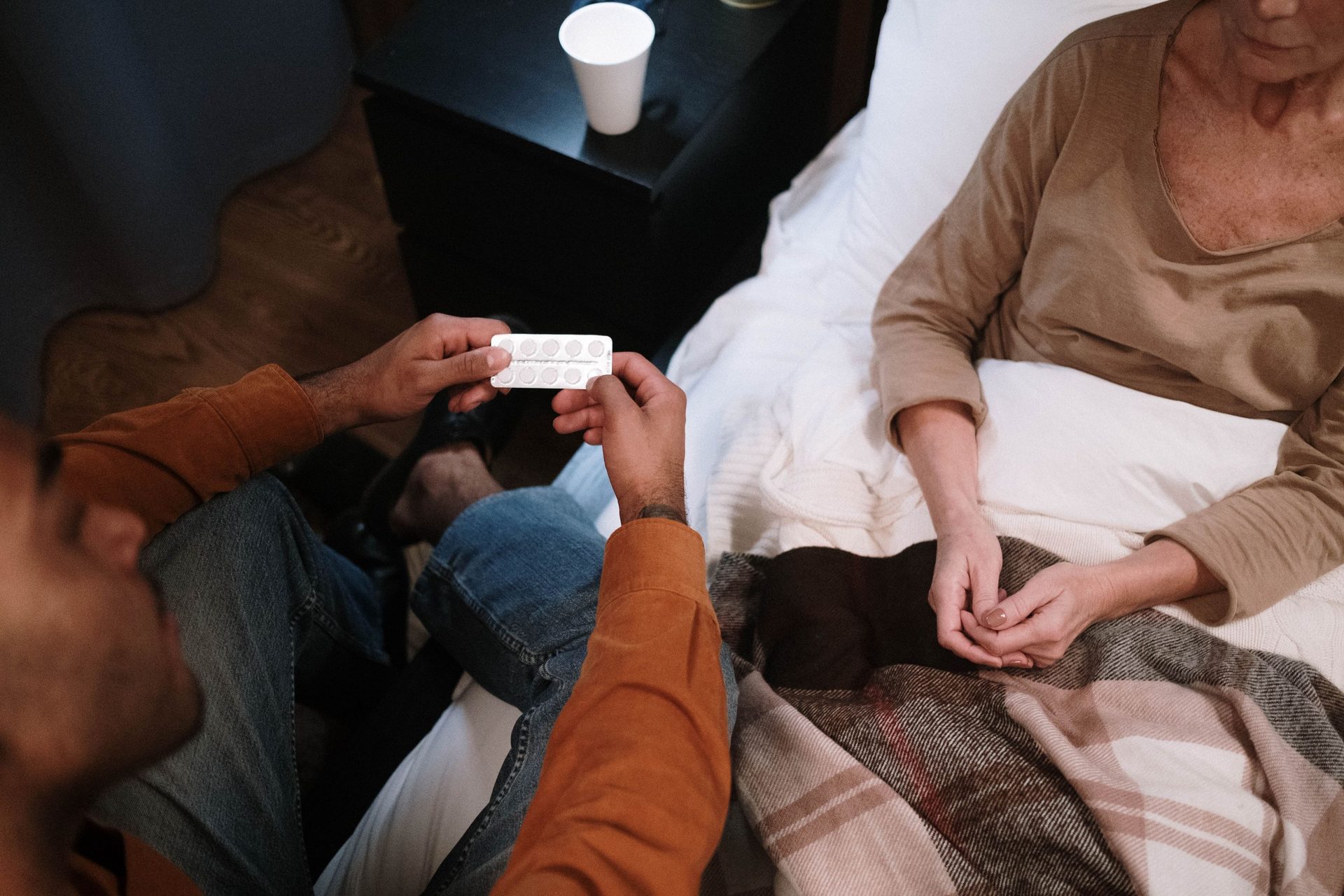
Home carer or nurse: who does what at home?
What a home carer can and cannot do, what district nurses do and how to get one free, when someone needs nursing at home, and how carers fit alongside.
A home carer helps with daily living: washing, dressing, the toilet, meals, medication reminders, moving around safely and company. A nurse is a registered clinician who assesses and treats health problems, such as wounds, injections, catheter problems and symptoms at the end of life. At home, most nursing comes free from the NHS district nursing team, through the GP or the hospital. Many people need both, and the two work side by side. JNP Sidona provides carers, not nurses.
Key points
- "Personal care" has a legal meaning: physical help with eating and drinking, the toilet, washing, dressing, oral care and the care of skin, hair and nails, or prompting and supervising someone to do these.
- Wound care, injections and other clinical tasks are nursing. A care worker can do a health task only when a registered healthcare professional has delegated it to them, with training and support.
- District nurses visit people at home who cannot easily get to a surgery. Ask the GP, or the ward before discharge.
- If the person's needs are mainly health needs, ask about NHS continuing healthcare, which can fund care at home.
- If you use a private nursing agency, check it is registered with the CQC and that its nurses are on the Nursing and Midwifery Council register.
What does a home carer do?
A home carer, or care worker, supports someone with the everyday things they can no longer manage alone. Home care agencies that provide this are registered with the Care Quality Commission for "personal care", which regulation 2 of the Health and Social Care Act 2008 (Regulated Activities) Regulations 2014 defines as physical help with:
- eating or drinking
- toileting
- washing or bathing
- dressing
- oral care
- the care of skin, hair and nails
It also covers prompting someone to do these things, and supervising them, where they cannot decide to do them alone. Around that core, carers usually help with meals, shopping, light housework, reminders to take medication, getting to appointments, and company. A carer often sees the person every day, so they are well placed to notice change: a red patch of skin, someone eating less, new confusion. Part of their job is to tell the family, and the GP or nurse, when they do.
What can't a home carer do?
A carer is not a clinician. They do not diagnose, decide treatment, or change a prescribed dose. Tasks that need clinical judgement belong to a nurse or another health professional:
- assessing and dressing complex wounds, leg ulcers and pressure sores
- giving injections
- removing stitches, clips or staples
- managing a syringe driver for symptom control at the end of life
- assessing a new symptom, or deciding whether someone needs to see a doctor
Health tasks delegated to carers
There is a middle ground. Some health tasks can be passed to a trained care worker by a registered healthcare professional, such as a district nurse, who stays responsible for the person's healthcare. These are called delegated healthcare activities. Skills for Care's guiding principles (current version November 2024) say such tasks "should only be delegated when care workers have received the appropriate learning, development and support". The CQC has told providers that services are expected to operate in line with those principles.
So the answer to "can a carer do this?" for a health task is: only if a named health professional has delegated it to that carer, trained them, and checked they are competent, and only if the agency agrees to take it on. Ask the agency directly.
| Task | Home carer | Nurse |
|---|---|---|
| Washing, dressing, the toilet, continence pads | Yes | Can, but at home this is usually the carer's job |
| Meals, drinks, help with eating | Yes | Advises if there are swallowing or nutrition problems |
| Reminders to take medication | Yes, as set out in the care plan | Reviews and changes treatment with the prescriber |
| Checking skin and reporting redness | Yes, and reports it | Assesses and treats pressure damage |
| A simple dressing | Only if a nurse has delegated it, trained the carer and signed them off | Yes, and decides whether it can be delegated |
| Complex wound care, injections, stitches | No | Yes |
| A specific health task such as stoma or catheter care | Only if delegated by a health professional, with training | Yes, and delegates where appropriate |
| End-of-life symptom control | Comfort, personal care, company | Yes, with the GP and hospice team |
What does a district nurse do, and how do you get one?
District nurses, also called community nurses, are NHS nurses who visit people at home when they cannot easily get to a surgery or clinic, for example after an operation, with a long-term condition or towards the end of life. Their work includes dressing wounds, giving injections, catheter care, looking after pressure areas and supporting people who are dying at home. The service is free on the NHS.
Age UK's factsheet on help at home explains that your GP can arrange community health services, usually at home, including a district nurse. Before a hospital discharge, ask the ward whether the district nurses have been asked to visit.
Local services differ. In Lewisham, for example, the district nursing service visits people who are temporarily or permanently housebound, from 8am to 10.30pm every day of the year. Referrals can come from a GP, from the hospital on discharge, or from relatives and carers, and the person must be registered with a Lewisham GP. Ask your GP how it works where you live.
When does someone need a nurse, not just a carer?
Ask for a nurse, through the GP, when there is:
- a wound, ulcer or pressure sore that needs dressing
- a medicine that has to be injected, or a change in treatment
- a catheter that blocks, leaks or keeps causing infections
- a stoma, feeding tube or other device that nobody has been trained to manage
- pain, breathlessness or agitation near the end of life that is not controlled
Someone can need nursing and still stay at home. District nurses visit for the clinical tasks; carers cover the rest of the day. If the person needs a nurse on hand at all times, a nursing home or NHS-arranged care may be the right comparison. NHS-funded nursing care, set at £267.68 a week (standard rate) from 1 April 2026, is a contribution for people living in a nursing home, not for care at home.
NHS continuing healthcare
If someone's needs are mainly health needs, they may qualify for NHS continuing healthcare. The NHS describes it as "free health and social care arranged and funded solely by the NHS", and says it "can be provided… in your own home or in a care home". It is not means-tested. Ask the GP, district nurse or social worker for a checklist assessment, and see our NHS continuing healthcare guide.
Private nursing at home
Some families pay for a private nurse, for example for extra visits, overnight nursing or care after private surgery. Before you agree anything:
- Check the agency is registered with the CQC. Age UK points out that agencies providing nurses or care workers for personal care must be registered. Search the CQC's directory.
- Check each nurse is registered. The NMC register shows who can practise as a nurse in the UK. Ask for the nurse's name and check it.
- Ask what "nurse" means in the quote. Some services use the word loosely. A registered nurse is on the NMC register; a care worker is not, however experienced.
- Tell the GP and district nurses. Private nursing should fit around the NHS team, not duplicate or contradict it.
How carers and nurses work together
A common pattern at home: the district nurse visits to dress a leg ulcer and check the skin, and the carers help with washing, dressing, meals and medication reminders each day in between. The carer's notes and observations help the nurse, and the nurse's instructions, such as keeping a dressing dry or changing position regularly, go into the care plan. If the carer sees something new, such as a dressing that has slipped or skin that is breaking down, they tell the nurse or GP the same day.
Questions families ask
Can a carer give my mother her insulin injection?
Not as a matter of course. An injection is a nursing task. A care worker can take on a health task only when a registered healthcare professional has delegated it to them, trained them and checked their competence, and the agency agrees. Ask the district nurse and the agency.
Is a carer cheaper than a nurse?
Usually, if you are paying privately, because a nurse is a registered clinician. But district nursing at home is free on the NHS, so most families pay for care and get nursing from the NHS. Get written quotes for anything private.
Who is in charge if a carer and a district nurse disagree?
On clinical matters, the nurse. The carer should report what they see; the nurse, GP or other health professional decides the treatment. Care agencies should have a way to raise concerns quickly with the NHS team.
Do live-in carers provide nursing?
Some agencies supply live-in nurses. A live-in carer is not a nurse, and nursing tasks still need a nurse, usually the district nurse. Ask any agency exactly what its live-in staff are qualified and registered to do.
How we can help
JNP Sidona is a CQC-registered home care agency on Lewisham High Street. We provide personal care, not nursing: our carers help with washing, dressing, meals, medication reminders and moving around safely, alongside the district nurses and the GP. They carry out a health task only when the NHS team has delegated it and trained them, as our complex care page explains. That can include simple dressings a district nurse has delegated and signed off, written into the care plan; complex wound care, injections, syringe drivers and clinical decisions stay with the nurses. If someone needs nursing, the GP is the place to start. We provide visiting care in Lewisham, nearby south-east London and parts of central and east London, and live-in care across London. See personal care, or ask Jackie, our registered manager, for a free home assessment.
Sources
- legislation.gov.uk: Health and Social Care Act 2008 (Regulated Activities) Regulations 2014, regulation 2, checked 26 November 2026
- Skills for Care: Delegated healthcare activities, guiding principles (November 2024), checked 26 November 2026
- CQC providers' bulletin: delegated healthcare activities, checked 26 November 2026
- Age UK: Factsheet 6, Finding help at home (September 2026), checked 26 November 2026
- NHS: NHS-funded nursing care, checked 26 November 2026
- NHS: NHS continuing healthcare, checked 26 November 2026
- Nursing and Midwifery Council: Search the register, checked 26 November 2026
- CQC: Find and compare care services, checked 26 November 2026
- Lewisham and Greenwich NHS Trust: District nursing, checked 4 November 2026
Talk to Jackie about care at home: ask for a call back or call 07446 010486.
Keep reading
Related guides

Talk it through with Jackie
No call centre and no obligation. Tell us what you are dealing with and we will tell you honestly whether we can help. We arrange and provide care; we cannot advise on benefit claims.
Looking for work rather than care? Apply online or read about carer jobs in London. Referring as a professional? Use our referral route.
Ask us to call you back
Thank you. Your request has been sent and we will call you back as soon as we can.