Complex Care at Home in London
Complex care at home, as we provide it, is non-nursing personal care for people with higher needs, such as after a stroke, with a physical disability or with a long-term condition. Clinical decisions and nursing stay with the NHS team. Visiting care is in Bexley, the City of London, Greenwich, Lewisham, Southwark, Tower Hamlets and Westminster, live-in care is London-wide, and it starts with a longer free assessment so we can tell you honestly whether we can staff it.
When standard home care is not enough
Some people need more than a general care visit. A stroke that has left one side weak and swallowing unreliable. A spinal injury. A condition that is going to keep changing for years. In those situations the question families are usually asked is whether it is time for a nursing home, and often the honest answer is that it does not have to be.
A word on the term. The same words are used for nursing packages, such as tracheostomy or ventilation care, and we do not provide those. Our complex care is home care for higher needs, working to a plan written with the clinicians already involved, and reviewed whenever the condition changes.
Where care ends and nursing begins
We are registered with the CQC for personal care, and our carers are not nurses. Clinical decisions and nursing stay with the NHS team: the GP, district nurses, the community matron or the specialist team. Carers carry out only the health-related tasks that team has delegated to them, after training and sign-off for that person, and they record what they do and escalate when something changes. If a package needs a nurse, we will say so at the assessment.
This way of working has a name: delegated healthcare activities. Skills for Care, working with the Department of Health and Social Care and the CQC, publishes guiding principles for it, covering person-centred care, governance and accountability, learning and competence, and monitoring and review. The professional who delegates a task keeps clinical oversight of it.
Is complex care at home the right service?
A good fit if
- the person's needs are higher than standard home care, but the clinical side is managed by the NHS team
- the care can be planned: regular visits, or live-in care where someone should not be alone
- the family and the professionals involved want the person to stay at home and can work to one shared plan
Not the right service if
- the person needs a nurse on hand, or clinical care such as ventilation, through the day or night
- care is needed awake through most nights. We do not currently provide waking nights, and one live-in carer cannot do it safely
- we cannot staff the package with carers trained for it. We will tell you, rather than send a general carer to a specialist package
What we support
Physical disabilities
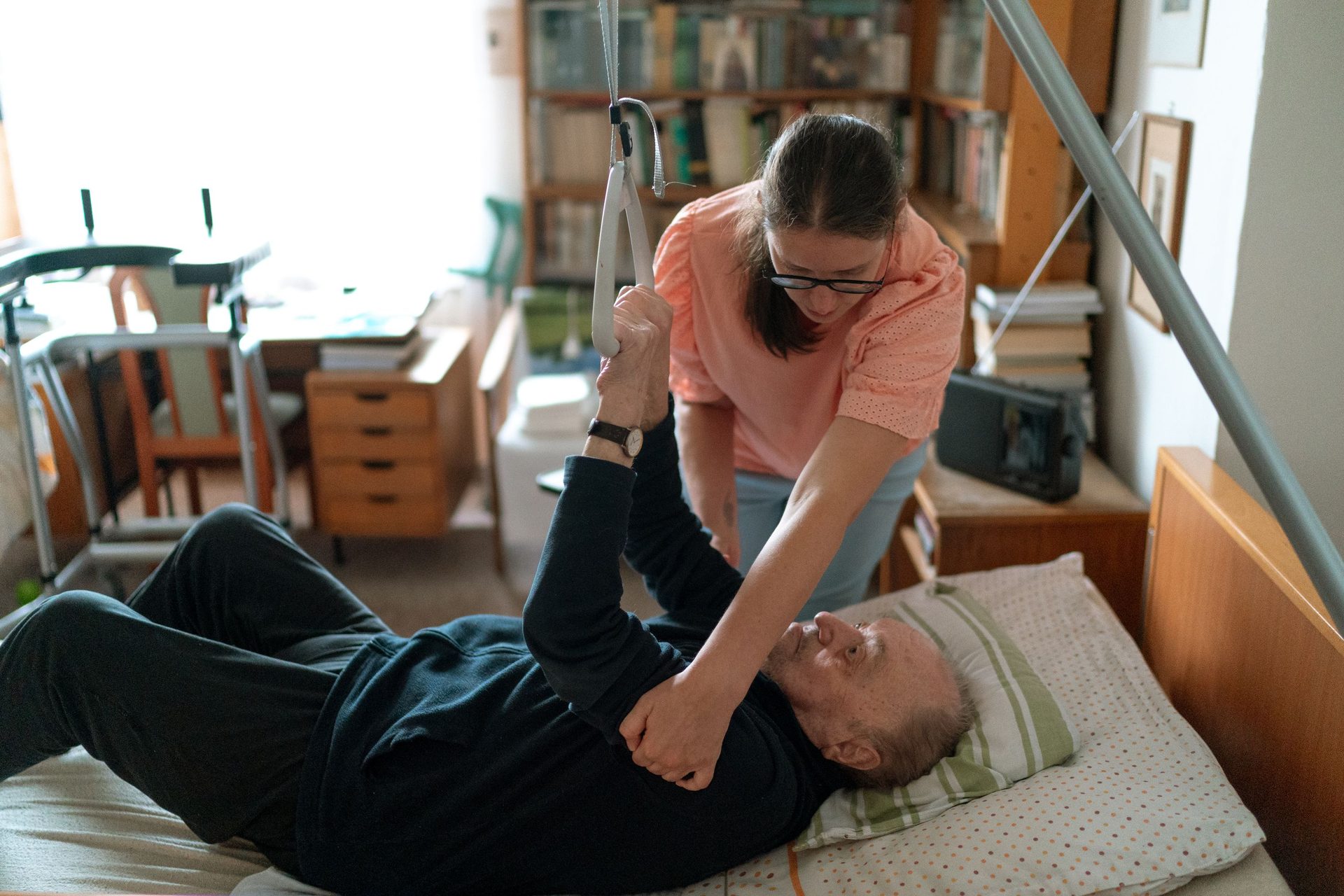
Support with transfers, moving and handling (using the equipment set out in the care plan), positioning, personal care and everything that comes with running a household when mobility is limited. The aim is independence where it is possible and proper support where it is not.
Stroke care
Recovery after a stroke is slow and uneven. We support the rehabilitation plan at home: mobility work set by the physiotherapist, communication support where speech has been affected, help with eating and drinking where swallowing is a concern, and the personal care that becomes difficult when one side is weak. Progress is often measured in months, and having the same carers throughout means someone notices the small gains. Our stroke care at home page goes into the first weeks home in more detail.
Tube feeding (PEG): ask us first
Tube feeding is a delegated healthcare task, so it can only be part of a package where the dietitian or nursing team delegates it and signs off the individual carer for that person. Please ask us before assuming we can cover it. Whether we can depends on having a carer who has been through that sign-off, and we will tell you plainly at the assessment. Where it is delegated, carers keep clear records and tell the nursing team quickly if the site or the person's tolerance changes.
Palliative and end of life care
Where the aim moves from recovery to comfort, we support people to stay at home. That is set out in full on our palliative and end of life care page.
Long-term conditions
Long-term conditions follow their own course, and care needs to keep pace with them. Care plans are reviewed whenever the condition changes, not once a year out of habit. Tell us about the diagnosis at the assessment and we will be clear about what we can and cannot support.
We will tell you if we are not the right service. Complex care goes wrong when an agency takes on a package it cannot properly staff. If a case needs nursing we cannot provide, or a level of cover we cannot sustain, we will say so at the assessment and point you somewhere better. That is worth more to you than a yes.
Coming home from a south-east or east London hospital
Most complex packages start on a hospital ward. In the boroughs our visiting carers cover, that is usually University Hospital Lewisham or Queen Elizabeth Hospital, Woolwich (both Lewisham and Greenwich NHS Trust), King's College Hospital, Guy's and St Thomas', the Royal London in Whitechapel, or St Mary's in Paddington for much of Westminster. The ward's discharge team, the community therapy team and the council's adult social care team usually plan the first weeks together.
Two things are worth knowing early. Council reablement and intermediate care, the short-term support to help someone regain independence at home, is free for up to six weeks under the Care and Support (Charging and Assessment of Resources) Regulations 2014. And longer-term care is planned after that, so it helps to involve us while the person is still on the ward. Our hospital discharge care page explains the process step by step.
After a stroke, the Stroke Association helpline (0303 3033 100) can help families with what comes next, from benefits to communication problems.
How complex care is arranged
Assessment comes first, and for complex cases it is a longer conversation. We work with whoever is already involved: hospital discharge teams, district nurses, GPs, community matrons, physiotherapists, speech and language therapists and social workers. Where the package is funded through NHS Continuing Healthcare or a local authority, we work within that framework. Our guide to NHS Continuing Healthcare explains who qualifies and how to ask for the checklist, and our guide to paying for care covers the other routes.
Cover can be built as visits through the day or as live-in care where someone needs a presence in the house at all times. We do not currently provide waking nights. If the nights need someone awake, we will say so at the assessment and talk through what the NHS team or the council can arrange.
Questions families ask
Can complex care be arranged for a hospital discharge?
Yes, and these are often urgent. Call us as early in the discharge process as you can, ideally while the discharge team is still planning, so the package is ready, not assembled in a panic on the day.
Can your carers do PEG feeding?
Only where the nursing or dietetic team has delegated it and signed off the individual carer for that person, so ask us before assuming it. Carers on a complex package need training for that person's specific needs. If we cannot staff a package with suitably trained carers, we say so at the assessment instead of sending a general carer to a specialist package.
Does complex care at home work out cheaper than a nursing home?
Sometimes, particularly for couples or where the package is visits rather than round-the-clock cover. For very high-dependency cases a nursing placement can cost less. We will be straight with you about which applies.
What happens if the condition gets worse?
The plan changes. That is the point of reviewing it. We increase cover or add training where we can, and we ask the GP or the NHS team to review the clinical side. If the point comes where home is no longer the right place, we will say so.
From our blog
Guides that may help
Talk it through with Jackie
No call centre and no obligation. Tell us what you are dealing with and we will tell you honestly whether we can help. We arrange and provide care; we cannot advise on benefit claims.
Looking for work rather than care? Apply online or read about carer jobs in London. Referring as a professional? Use our referral route.
Ask us to call you back
Thank you. Your request has been sent and we will call you back as soon as we can.