Upney · Barking and Dagenham
Live-in Care in Upney, IG11
A resident carer for the Becontree-era houses around Upney Lane, often arranged when someone is ready to leave hospital but not ready to manage the stairs alone. We see the house first, free of charge.
Live-in care often comes up on a hospital ward. Someone in their eighties has had a fall, a stroke or a spell of pneumonia, the ward is ready to discharge, and the family know the house has a steep staircase with the only toilet at the top. Around Upney Lane, two-thirds of households own their home, and over a quarter own it outright, so the question is often not whether to stay but how. This page is about making that work.
Can Dad come home to a house with a steep staircase?
Often, yes, if the house is ready before he arrives. Most homes near Upney station are interwar Becontree houses: two storeys, a narrow staircase, the bathroom upstairs. The ward will want to know how he will manage those stairs, and "his wife will help" is not always a safe answer when she is eighty-two herself.
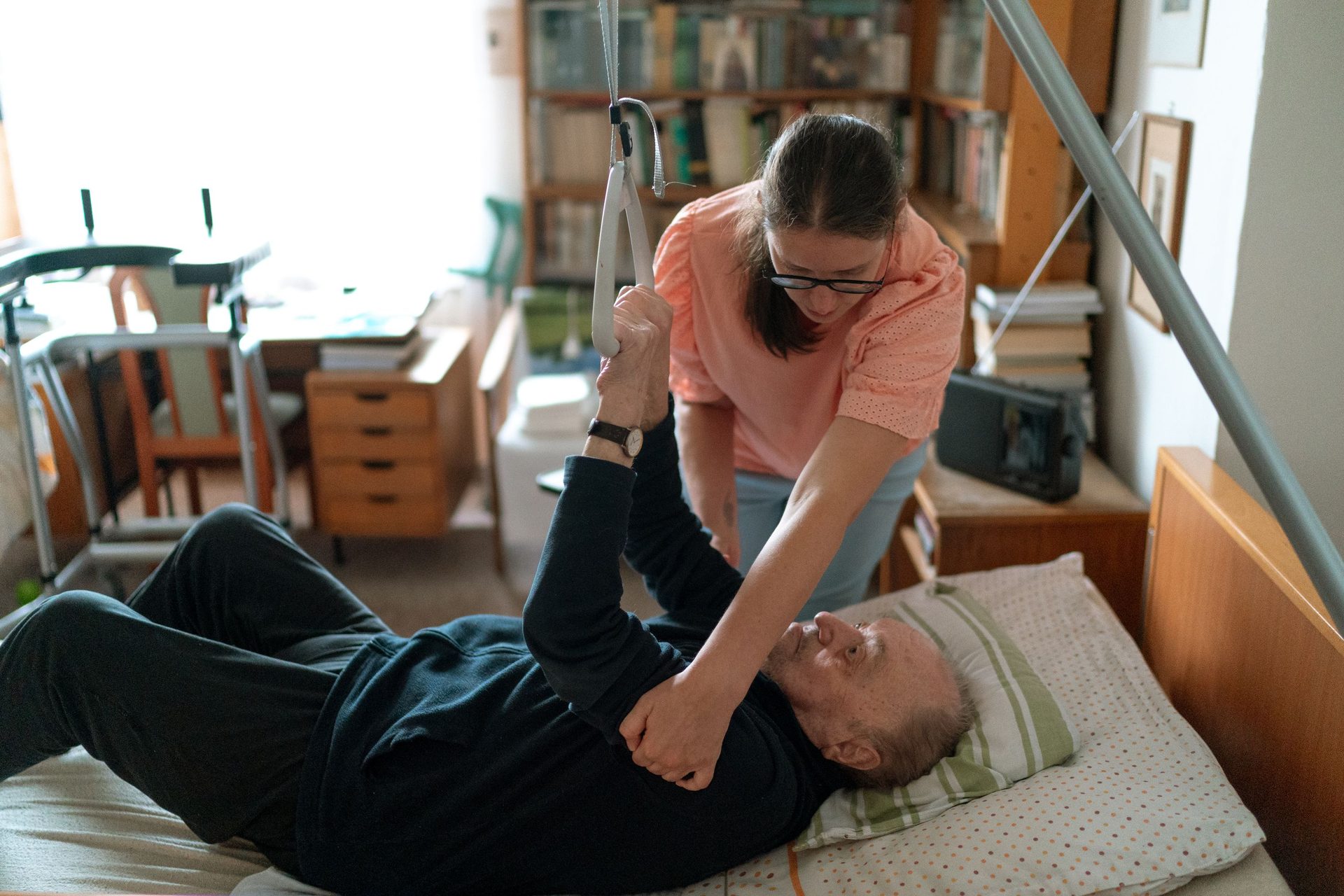
A carer living in changes the conversation. The hospital's occupational therapist can plan around someone being there for every trip to the toilet, every wash and every attempt at the stairs. The usual choices are:
- Ground-floor living for a while: the front room becomes his bedroom, with a commode and washes at the kitchen sink until his balance returns.
- A stairlift: worth it if he will be living in the house long term and the staircase suits one. As owners, the family may claim a Disabled Facilities Grant, after a means test, once a council OT has recommended the work.
- Supervised stairs: where a physiotherapist has cleared him to climb with someone beside him, the carer walks every flight with him.
Where everyone sleeps when the bed comes downstairs
If Dad moves to the front room, the carer still has their own room upstairs, usually the box room, and hears him at night through a baby monitor or pendant alarm. If Mum stays upstairs in the main bedroom, the spare room left over is the carer's. In a two-bedroom house where both partners still sleep upstairs in separate rooms and there is no third room, live-in care may not fit, and we will tell you at the assessment.
Reablement first, live-in care after?
Reablement is the council's free short course of support after illness (details on our borough page). Check with the ward that it has been asked for. Some families use live-in care alongside it in the first weeks; others find reablement is enough and then need us only for a fortnight's respite later. Referral comes from a professional, so raise it before the date is set. Our approach on the ward is set out under hospital discharge.
The urgent treatment centre on Upney Lane
Barking Community Hospital, a short walk up Upney Lane from the station, has a GP-led urgent treatment centre that NELFT lists as open 8am to 10pm. It is not an A&E. With a carer living in, someone is there to judge whether a fall or a cut needs it, take your relative there and back, and tell the family what was said. Anything serious, or anything after 10pm, means 999, 111, or the A&E at King George or Queen's. We write into the care plan when the carer should use the treatment centre, when to ring 111, and when to call you. The same building is a base for the district nurses, who can come to the house for wound care and injections.
Exercises the physio left behind
Hospital physiotherapists often send people home with a sheet of exercises. With a carer in the house, the routine gets done daily, and you hear early if a movement gets harder. Getting as far as the lakes in Mayesbrook Park, or the boating lake in Barking Park, can become a goal to work toward.
Changeovers at Upney
Upney sits a single District line stop beyond Barking, where the Hammersmith & City line, c2c and Overground connect. Route 62 stops at Upney station too. If a carer arriving with luggage needs step-free access, check TfL's current station information before they travel. Parking around Upney is mostly uncontrolled, but the council has added zones near stations; if your road is in one, a short-stay Community and Healthcare permit covers a car on changeover day.
Funding
Owning the house does not rule out council help, since a home the person lives in is ignored for care delivered there. Savings decide it: past £23,250, the person pays for everything. Step-by-step council detail is on the borough live-in page. While your relative is on the ward, it is worth asking staff to complete the NHS Continuing Healthcare checklist. Shorter visits are covered on home care in Upney.
Live-in care elsewhere in Barking and Dagenham
Living in Upney
Homes and health services in Upney
Homes in Upney
Interwar terraces and semis, much of it Becontree estate housing.
NHS hospitals
Barking Community Hospital and Queen's Hospital
Memory and dementia
NELFT Memory service - Barking and Dagenham
Dad's bed is moving to the front room. Can the carer still sleep upstairs?
Yes. The carer's room stays upstairs and a monitor or pendant does the listening. Should he need someone repeatedly through the night, a different set-up is needed, and we would raise it first.
The ward says Mum can go home once care is in place. How much notice do you need?
The more the better. Phone when the doctors first say 'home soon', not once transport is booked. We will try to meet her on the ward and then confirm whether a suitable carer can start that day.
Can the live-in carer help with the physio exercises the hospital gave her?
Yes. Copy the sheet into the care plan and the carer will run through it with her daily and flag anything that becomes a struggle.
Mum and Dad own the house. Will the council still help?
Quite possibly. The means test disregards the house for care at home and looks at savings and income. Start with a call to the council's intake line.
Nearby
Nearest areas to Upney outside Barking and Dagenham
Closest first, measured in a straight line from the centre of Upney.